

mystery & truth
on Anthem, individualism, and what's ahead

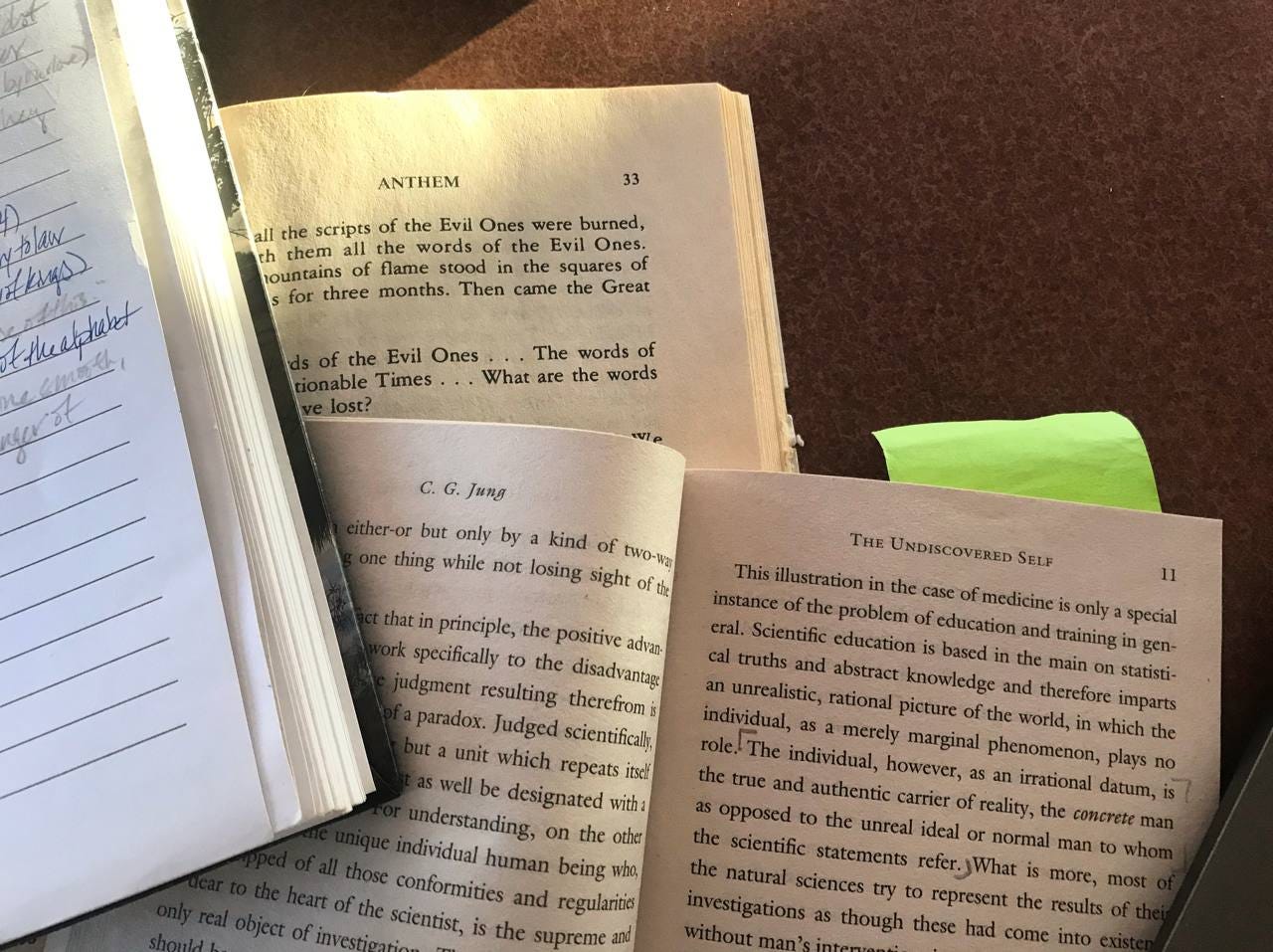
My cousin walked in and said, “Here, maybe you can make sense of this,” as he handed me a small book.
I flipped it over, thumbed the pages. A tiny book, The Undiscovered Self by Carl Jung. Of all classic psychologists I studied in high school and college, Jung seemed to be one of the more sane ones. Which, we should acknowledge right out of the gate, isn’t really saying much.
It’s been slow going but the pages are small and I started reading it alongside Anthem, another tiny book that is also about individualism…sort of. And this is how it works, because although as far as I can tell neither of these authors knew God, He knew them. And God knows how to put a curriculum together for those of us who are willing to pay attention.
So I didn’t plan on reading Jung’s case for individual worth at the same time as Anthem’s case against collectivism, but here’s what happened:
Judged scientifically, the individual is nothing but a unit...and could just as well be designated with a letter of the alphabet.
— Carl Jung, The Undiscovered Self
And:
Our name is Equality 7-2521, as it is written on the iron bracelet which all men wear on their left wrists…
— Ayn Rand, Anthem
And also:
The individual, however...is the true and authentic carrier of reality, the concrete man as opposed to the unreal ideal or normal man to whom the scientific statements refer.
— Carl Jung, The Undiscovered Self
Maybe Jung didn’t know it, but he was talking about the Imago Dei, how we reflect the Maker in countless individual facets, while the enemy (or the State, but I repeat myself) continually tries to sand us all down into a collective sameness — a smooth, perfect average that represents no one, but attempts to control everyone.
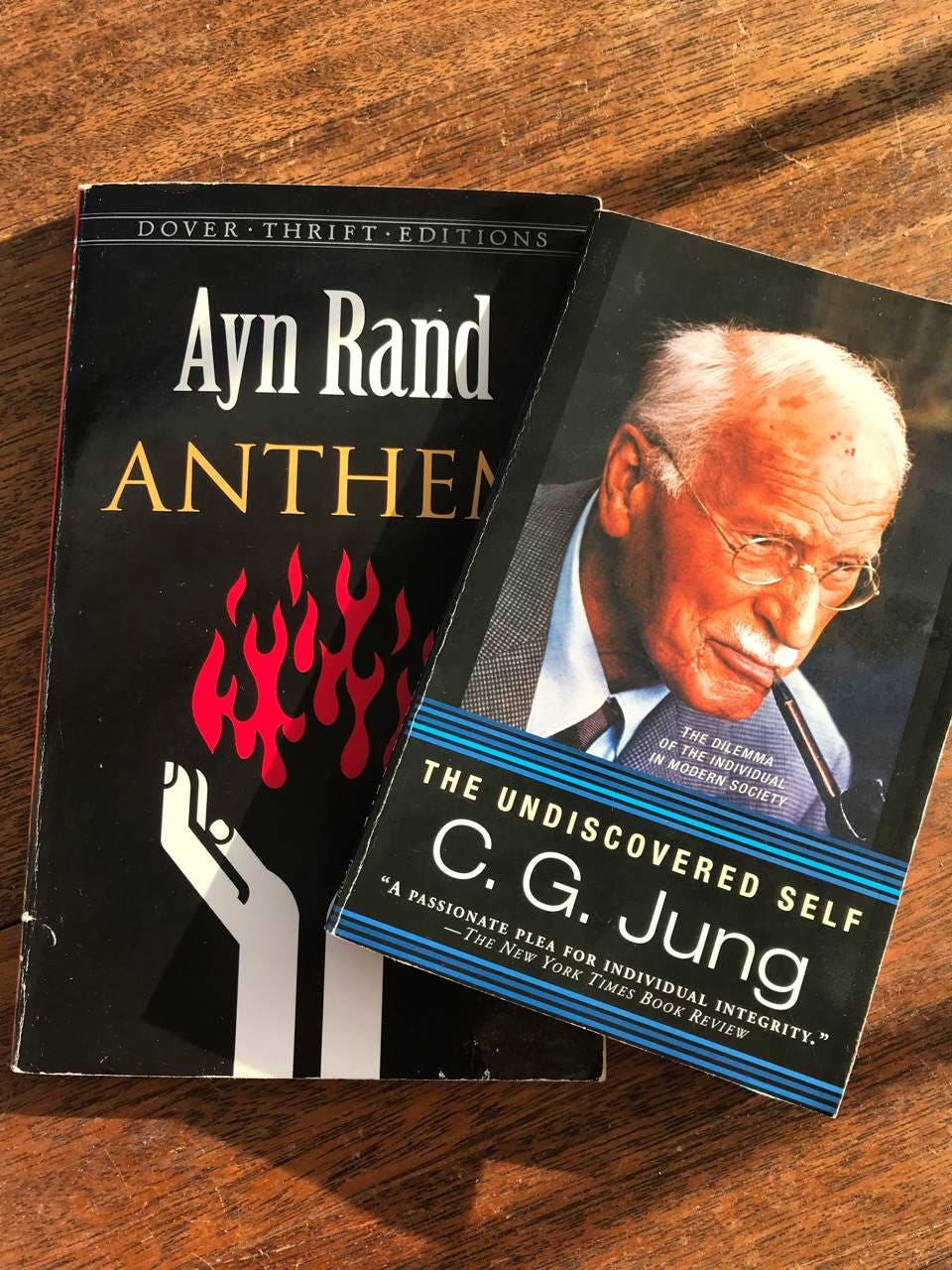
Anthem is an illustration of escape from legalism, when you realize questions and honesty are not only allowed but encouraged. This can be hard for us until we realize that God protects us; it’s not the other way around. God is not afraid of our questions.
May the Council have mercy upon us! We had no wish to write such a questions, and we knew not what we were doing till we had written it. We shall not ask this question and we shall not think it. We shall not call death upon our head.
— Ayn Rand, Anthem
In the beginning of Equality’s journey, we have fear of man, which leads to slavery. This legalism is utterly opposed to growth and honesty, and will never allow the pursuit of mystery and truth.
Here’s Jung again, as though he was reading along with us:
Instead of moral and mental differentiation of the individual, you have public welfare and the raising of the living standard.
The goal and meaning of individual life (which is the only real life) no longer lie in individual development but in the policy of the State, which is thrust upon the individual from outside and consists in the execution of an abstract idea which ultimately tends to attract all life to itself.
The individual is increasingly deprived of the moral decision as to how he should live his own life, and instead is ruled, fed, clothed, and educated as a social unit, accommodated in the appropriate housing unity, and amused in accordance wit the standards tat give pleasure and satisfaction to the masses.
— Carl Jung, The Undiscovered Self (emphasis mine)
Huh. Contrast that with how God is unafraid of our questions, and wants us to search for the answers.
It is the glory of God to conceal things,
but the glory of kings is to search things out.— Proverbs 25:2
and
For the wrath of God is revealed from heaven against all ungodliness and injustice of those who by their injustice suppress the truth.
— Romans 1:18
So let’s talk a bit about that pursuit of mystery and truth, because there’s more at stake here than the liberation of a fictional character. You probably know several people right now who are on the same journey as Equality.
: spoilers ahead : proceed with caution :
I love that Anthem ends with a taste of freedom. One of the overarching messages is escape from total control and slavery, and how there is a world outside if you can find it. A person can’t always, physically. But in the world of Anthem, it’s there. (It’s here, too, of course.)
On the surface, the end of the book seems to be about self worship because Equality realizes that he is the purpose of his own existence. As Christians we cringe at that, but consider his progression: He came from complete ignorance, control, and slavery (the enemy’s tactics) and moved to freedom, discovery, and revelation (these are the ways of God).
This is only going from one terrible belief system to another if the timeline stops there.
But if the timeline continues, it is the progression toward understanding that something Greater is out there. Equality doesn’t understand that yet. Most people don’t, instantaneously.
For what can be known about God is plain to them, because God has made it plain to them. Ever since the creation of the world God’s eternal power and divine nature, invisible though they are, have been seen and understood through the things God has made.
— Romans 1:19-20a
So Equality recognizing his own personhood is the first part of that. He is now free, potentially walking toward truth. He still misses the point (“the guiding star is within me…they point to me”) but he is on the way to discovering it. As far as we know, Ayn Rand did not discover it, but this character of hers who went from zero identity to discovering his own individual existence could make his way there.
Ayn Rand clearly had a bone to pick with religion and she swung her pendulum to other end of the extreme. Her tone in chapter 11 smacks of one who is just as angry with legalistic Christianity as she is with communism and collectivism.
The fortune of my spirit is not to be blown into coins of brass and flung to the winds as alms for the poor of the spirit.
— Anthem
Maybe no one showed her true freedom in being surrendered to Christ. It sounds like she only saw a form of so-called Christianity that looked no different from the slavery of communism. These messages are still being spoken today, and still driving people away from the Kingdom by their misrepresentation of it.
Like Anthem, Jung’s book also has solid truth about the value of individual worth, but then it veers into statements that hang on a skewed misunderstanding of scripture and Christianity, and misses some of the very things it’s trying to argue for. Both of these books miss the forest for the trees as they try to send their message.
And this is the danger of classifying and categorizing without considering nuance, the big picture, or other things we might not understand. Like Jung, Rand knew just enough of scripture to abuse it and turns its phrases to her own meanings.
For in the temple of his spirit, each man is alone. Let each man keep his temple untouched and undefiled.
— Anthem
This is our main character speaking, and he is so close, yet still so far.
In the temple of his spirit he is alone, but he doesn’t have to be. And if he recognizes Who made that temple in the first place, and Who loved him into being in the first place, and Whose image he was made in, he would not revel in its sterile vacancy.
This is the journey so many are still on.
Equality is wounded, afraid of any control after such abuse. And like many who’ve survived such situations, he is possessive of his own freedom because the taste of it is new and intoxicating, and he recognizes it as precious. And it is.
But he has yet to learn that His Maker sees him as precious, too.
Just as he hates the word We for how it was abused, We in the right context is a beautiful thing. So is surrender in the right direction, to the only One who is worthy of it.
Until he understands that, his possessiveness over his newfound liberation is just another form of slavery. If and when he invites his Maker in, that empty room will be furnished with all matter of precious things and he will find meaning beyond just himself.
By wisdom a house is built,
and by understanding it is established;
by knowledge the rooms are filled
with all precious and pleasant riches.— Proverbs 24:3-4
So at the end of the book, Equality has found some meaning beyond slavery, but he hasn’t found true freedom yet. He might be on the way, though.
and now, to our current book

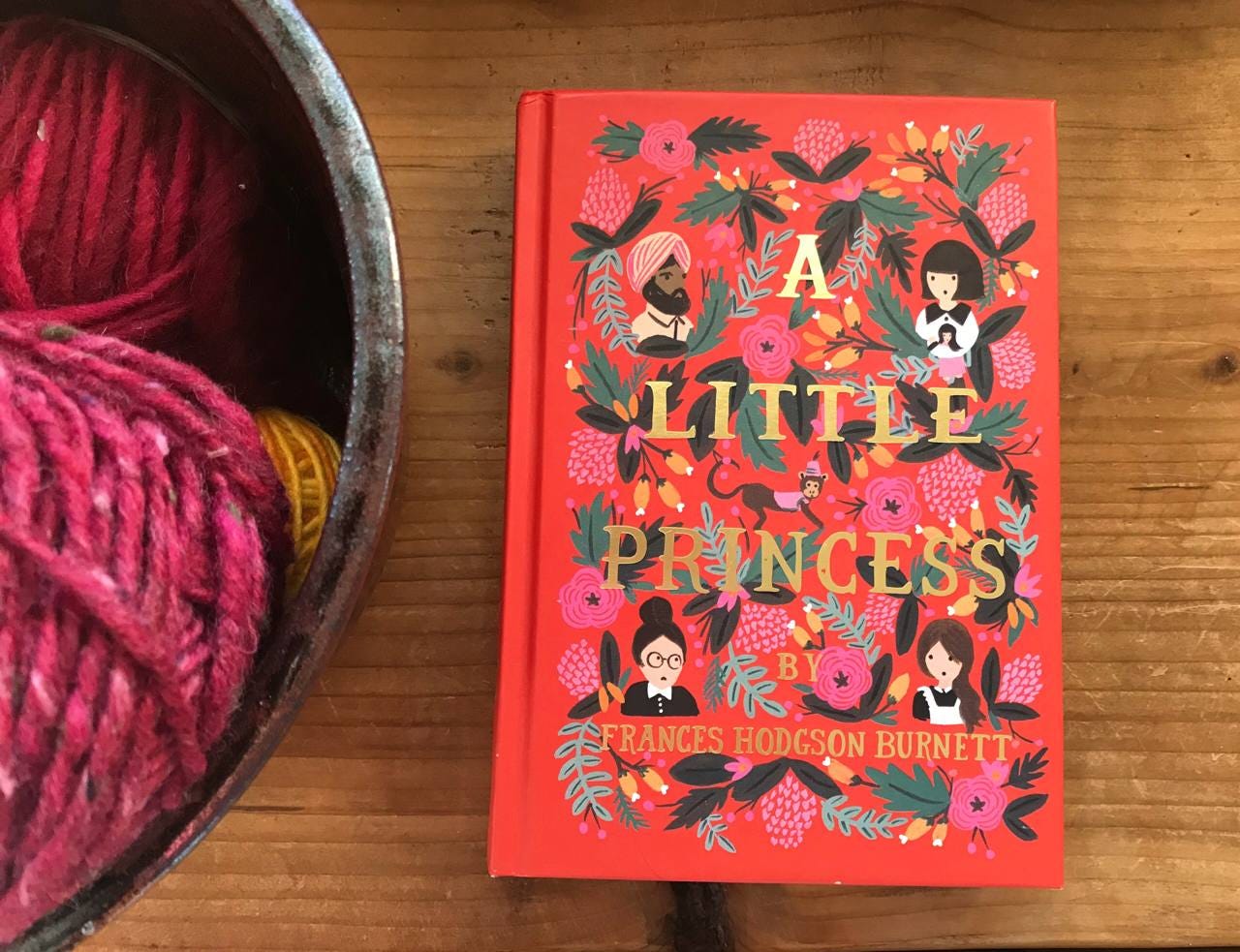
We started A Little Princess just last week and it’s available everywhere (online, in audio, at your library, at ThriftBooks, and I think we have at least three copies around here) so you still have time to jump in and join us. It is SO MUCH LIGHTER than Anthem. There’s poetic justice, classy vengeance, and wisdom galore.
Also! I’ve opened the poll for the next round of books, so go vote here. It’s a little early, but it looks like we’ll be reading Great Expectations soon. YAYYYYY
And one more quote from Jung if you can handle it; I thought this was hilarious but I’ve been in the weeds of Greek and theology for the last few months and my taste in humor might currently be as skewed as Rand’s existential conclusions.
Anyway, here you go:
Everywhere in the West there are subversive minorities who, sheltered by our humanitarianism and our sense of justice, hold the incendiary torches ready, with nothing to stop the spread of their ideas except the critical reason of a single, fairly intelligent, mentally stable stratum of the population.
One should not, however, overestimate the thickness of this stratum.
— Jung, The Undiscovered Self
Seriously, that made me laugh out loud. I should probably take a break and go read some more Wodehouse.
Happy learning,
Shannon

I like your optimism on Equality’s behalf! (It’s not just you, the Jung quote made me snicker, too.)
Good take. Made me think of the house that is exorcized of one set of demons only to be inhabited by another set unless you fill it with Christ.
And that last Jung quote IS hilarious! (and prophetic).